Times Square, a bustling hub in Midtown Manhattan, captivates millions annually with its radiant displays and cultural richness.
As a pivotal point for transportation and the core of Broadway's Theater District, its economic and cultural impact on New York City is profound.
This article explores Times Square's geographical layout, historical evolution, key landmarks, and cultural diversity, providing an in-depth understanding of its significant role in the urban fabric of the city.
Times Square, a major commercial intersection in Midtown Manhattan, is not geometrically a square but has a bowtie shape, bounded by West 42nd Street, West 47th Street, 7th Avenue, and Broadway.
This vibrant hub, known for its iconic digital billboards, glows with an energy that is palpable.
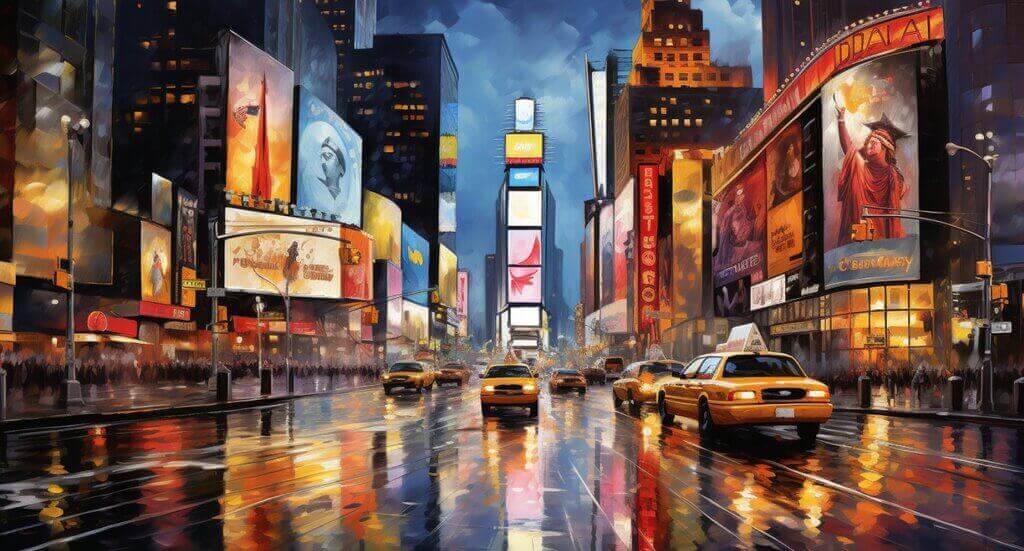
The plaza is divided into two triangles: the southern triangle, known officially as Times Square, and the northern triangle, named Duffy Square.
Both areas serve as significant landmarks, featuring notable installations like the TKTS discount ticket booth and the statue of George M. Cohan, a celebrated figure in American entertainment.
These elements, combined with the ceaseless flow of people, contribute to the dynamic character of Times Square, making it a central point of interest in the heart of New York City.
Historical transformations have marked the evolution of this renowned commercial intersection, once known as Longacre Square, into the globally recognized hub it is today.
Times Square's transformation commenced in earnest in 1904, following The New York Times' relocation of its headquarters to the district.
It was this pivotal shift that prompted the area's rechristening, signifying the commencement of a new era.
The annual New Year's Eve ball drop, a tradition initiated in 1907, affirmed Times Square's ascendancy as an international cultural nexus.
Today, often referred to as the Crossroads of the World, Times Square stands as a testament to New York City's vibrant dynamism, its luminous billboards a beacon to millions of annual visitors, representing the pulse and spectacle of the Broadway Theater District and the Great White Way.
Navigating through the iconic intersection in Midtown Manhattan involves a combination of bustling subway stations and pedestrian-friendly spaces, serving as a testament to the efficiency of urban transportation systems.
Times Square, a transport hub, is served by two major stations, Times Square–42nd Street and 42nd Street–Port Authority Bus Terminal, which together accommodate over 200,000 passengers daily.
This intersection also marks the eastern terminus of Lincoln Highway, the first road to span the United States.
Additionally, the pedestrian-friendly design enables efficient movement of the hundreds of thousands of people who traverse this area daily.
The efficient transportation, combined with 24/7 businesses and a vibrant atmosphere, make Times Square a powerful symbol of urban dynamism and efficiency.
Must-see landmarks within this renowned commercial intersection include the TKTS discount ticket booth and a commemorative statue of George M. Cohan, underscoring the area's rich cultural and historical significance.
The TKTS booth, an unmissable icon of Times Square, offers discounted Broadway and off-Broadway tickets, thus facilitating access to the city's vibrant theater scene.
Further enhancing the area's cultural allure, the statue of George M. Cohan stands as a tribute to the influential entertainer and playwright, renowned for his contribution to American musical theatre.
Additionally, the iconic billboards and digital advertisements provide a captivating visual spectacle, reinforcing Times Square's status as a symbol of New York City's dynamism.
Collectively, these landmarks encapsulate the power, creativity, and vitality inherent in this globally recognized intersection.
The bustling atmosphere of this renowned intersection presents an exhilarating sensory experience, characterized by the ceaseless hum of activity, the dazzling array of digital billboards, and the diverse mix of locals and tourists from around the globe.
With an estimated 330,000 people traversing its grounds daily, Times Square stands as a testament to the energetic spirit of New York City.
Read more: Unforgettable Experiences in New York: Central Park, Chinatown, and More!
The vibrant ambiance is further amplified by the 24/7 businesses and entertainment hubs that contribute to its reputation as the city that never sleeps.
This pulsating heart of the city offers a dynamic stage where cultures converge, commerce thrives, and dreams materialize.
Thus, Times Square embodies the power and potential of urban vitality, serving as an emblem of the unstoppable momentum of human enterprise.
Cultural diversity and a broad spectrum of activities define this globally recognized intersection, making it a dynamic meeting point for individuals from all walks of life.
Times Square serves as a testament to the vibrant multicultural fabric of New York City, providing a platform for a myriad of cultural expressions and global interactions.
This bustling hub, adorned with dazzling digital billboards, is a magnet for a multitude of artistic activities, ranging from Broadway shows to street performances.
Furthermore, it acts as a fulcrum for significant annual events, such as the New Year's Eve ball drop, attracting millions of spectators, both on-site and via broadcast.
Similarly, Times Square's gastronomic offerings reflect the city's cultural mix, offering culinary delights from across the globe.
This intersection indeed embodies the essence of New York City's dynamic and diverse spirit.
Significant economic contributions are made by this globally recognized intersection to the financial health of New York City, with its bustling tourism industry and numerous business establishments.
The vibrancy of Times Square, attracting an estimated 50 million visitors annually, fuels commerce and generates substantial revenue, thus bolstering the city's financial fortitude.
More interesting places in New York, NY
Furthermore, with an influx of over 330,000 individuals daily, businesses thrive, creating employment opportunities and facilitating economic growth.
Additionally, the transportation hub status of Times Square ensures constant activity, further energizing the economic engine.
Lastly, the historical significance and unique geographical landmarks of this area augment its appeal, drawing tourists and locals alike, which translates into consistent economic vitality for the city.

